
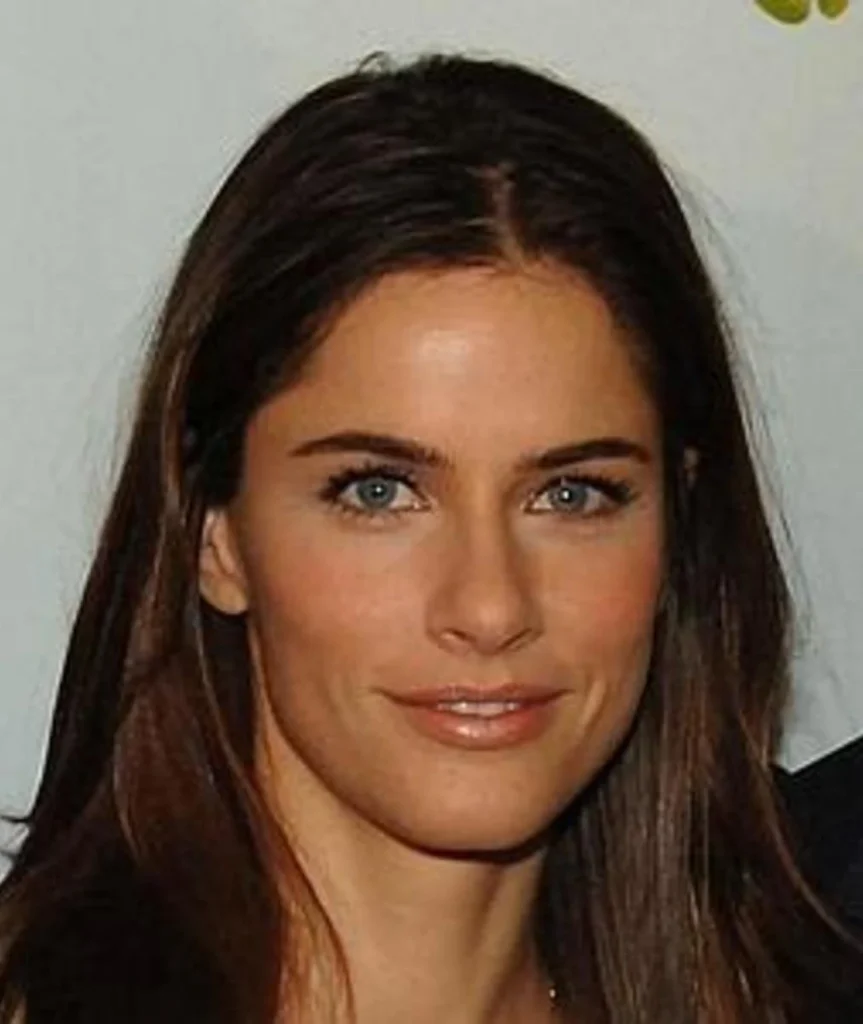
Amanda Peet has a combined net worth of approximately $100 million with her husband David Benioff, the co-creator of Game of Thrones. That figure tells one story. The career trajectory tells a more interesting one. Peet is arguably the most talented American actress of her generation to never receive the leading-role status her abilities warranted. She delivered strong performance after strong performance across three decades — in studio comedies, independent dramas, prestige television, and a Nancy Meyers film that grossed $266 million — and Hollywood responded the way it responds to most women who don’t fit neatly into a marketable category. It moved on.

Except Peet didn’t. The Amanda Peet net worth story isn’t about disappearance. It’s about metamorphosis. The woman who Hollywood tried to slot as a pretty ingenue in 2000 became a playwright, a showrunner, a vaccination advocate, and the creative partner of one of the most powerful men in television. She didn’t vanish. She evolved past the industry’s ability to categorize her. The Hamptons crowd — fluent in the art of reinvention — should recognize the move.
The Before: A Lawyer’s Daughter Who Chose Uta Hagen Over Corporate Law
Amanda Peet was born on January 11, 1972, in New York City. Her father, Charles Peet Jr., was a corporate lawyer. Her mother, Penny Levy, was a social worker. They later divorced. At seven, Peet moved to London with her family and spent four years absorbing a different country’s relationship with language, performance, and class. Then back to Manhattan, where she developed what she later described as an obsessive relationship with theater. After a performance she loved, she couldn’t leave the building. She’d sit and stare at the empty stage.
Instead of pursuing acting immediately, Peet enrolled at Columbia University and earned a degree in American History. That choice — studying the past before performing the present — gives her career a specific intellectual foundation that most actors lack. While at Columbia, she began training with Uta Hagen, the legendary acting teacher whose students included Al Pacino, Robert De Niro, and Matthew Broderick. Hagen’s technique demanded emotional truth over technical showmanship. Peet absorbed that philosophy completely, which is precisely why Hollywood never quite knew what to do with her. Emotional truth is harder to market than technical showmanship.
Her first screen performance was a Skittles commercial. Then an uncredited appearance on The Larry Sanders Show in 1992. Then small roles in Law & Order, Seinfeld, and a series of independent films that co-starred actors significantly more famous than she was — George Clooney, Michelle Pfeiffer, Jennifer Aniston, Cameron Diaz, Sean Connery. Peet kept showing up in rooms full of bigger names and consistently proving she belonged. The problem wasn’t talent. It was timing and category.
The Pivot: The Whole Nine Yards and the Window That Opened Too Narrow
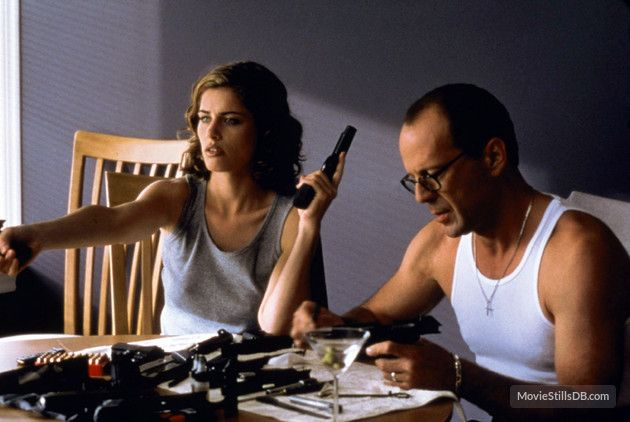
In 2000, Peet appeared in The Whole Nine Yards alongside Bruce Willis and Matthew Perry. The mafia comedy grossed $106 million worldwide. Roger Ebert singled out Peet’s performance as “perfect.” People Magazine named her one of the 50 Most Beautiful People in the World. She won the Young Hollywood Award for Best New Style Maker. Every metric suggested a breakout. The trajectory appeared set: Amanda Peet was about to become a movie star.
What happened instead is a case study in how Hollywood’s category system fails specific types of talent. Peet was beautiful enough for romantic comedies but too intelligent for the ones being written. She could handle drama — Igby Goes Down, Changing Lanes with Ben Affleck, Syriana — but the industry didn’t build dramatic vehicles around women her age who looked like her. The window between ingenue and character actor, which Harvard Business Review has documented as disproportionately narrow for women in entertainment, closed before Peet could find the right project to wedge it open.
Consequently, Peet spent the 2000s delivering excellent work in films that either didn’t need her to be the lead or didn’t give her enough material to prove she should be. Aaron Sorkin cast her in Studio 60 on the Sunset Strip — a show smart enough to deserve her — and NBC cancelled it after one season. The pattern repeated: strong performance, insufficient platform, next project. It’s the most common career trajectory for talented women in Hollywood. That doesn’t make it less wasteful.
The Climb: Something’s Gotta Give and the Role That Proved Too Much
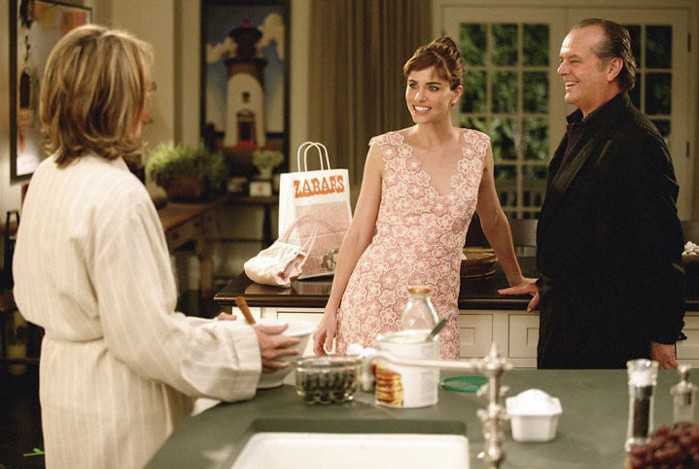
Nancy Meyers cast Peet as Marin Barry in Something’s Gotta Give — Harry Sanborn’s young girlfriend, Erica Barry’s daughter, the catalyst who brings the two leads into proximity. In a lesser film, Marin would be a caricature: the bimbo, the trophy, the punchline. In a lesser actress’s hands, she would fade into the production design.
Peet refused to play it that way, and Meyers was smart enough to write it that way too. Marin is genuinely warm, perceptive, and self-aware in the film. She likes Harry without illusions about what their relationship actually is. She loves her mother without resentment or competition. When she recognizes what’s developing between Harry and Erica, she steps aside with grace rather than drama. That restraint — choosing dignity over spectacle — is one of the film’s most quietly progressive choices.
The performance also revealed something about Peet that the industry should have noticed more carefully. She could make a supporting character feel like a complete human being in limited screen time — a skill that requires more craft than carrying a film where you’re in every scene. Directors who understood ensemble work recognized this. The commercial machinery that decides who gets offered $15 million for a romantic comedy lead did not. In Hamptons terms, Peet was the person at the dinner party everyone remembered fondly afterward but somehow never thought to invite back. The oversight says more about the hosts than the guest.
The Hamptons Chapter: What the East End Understands About Being Underestimated
There’s a specific experience familiar to women in the Hamptons social scene that Peet’s career trajectory mirrors almost exactly. You arrive with credentials. You perform well. You’re told you’re impressive. Then you watch less qualified people receive the opportunities you earned while you’re directed toward roles that use ten percent of your capacity. The women who navigate this — who build influence sideways when the direct path is blocked — tend to be the most formidable people in any room they enter.

Peet navigated the blockage by going to television when film stopped calling. Togetherness on HBO gave her a complex, adult role that critics praised. Brockmire on IFC ran four seasons and allowed her to demonstrate a comedic range the film industry never explored. Dirty John let her play Betty Broderick — a true-crime role requiring the kind of emotional extremity that awards campaigns are built around. Paramount+ cast her in Fatal Attraction. Apple TV+ put her in Your Friends & Neighbors. Each role was strong. None generated the cultural conversation her talent deserved.
The pattern reveals something the Hamptons audience instinctively understands: the difference between being valued and being visible. Peet was always valued — directors sought her, critics praised her, co-stars admired her. Visibility, however, is a separate currency in Hollywood, and it’s distributed according to rules that have nothing to do with talent and everything to do with marketability, timing, and the specific demographic category a studio’s algorithm assigns you. Peet’s category — too smart for mainstream comedy, too beautiful for indie credibility, too principled to chase visibility at the expense of craft — didn’t exist in the system. So the system simply didn’t see her. Keanu Reeves, her co-star in the same film, solved this by being so genuine the system couldn’t ignore him. Peet’s genuineness was quieter. Equally real. Less rewarded.
What She Built: The Chair, David Benioff, and the Second Act That Mattered More
In 2006, Peet married David Benioff, the screenwriter and producer who would go on to co-create Game of Thrones, the most commercially successful television series of its decade. They have three children and split time between Los Angeles and New York. The combined Amanda Peet net worth of approximately $100 million reflects both her three-decade acting career and Benioff’s considerable earnings from the most valuable franchise in HBO history.
More significantly, Peet used the creative partnership to evolve past the category that had constrained her. In 2021, she co-wrote and executive produced The Chair for Netflix — a six-episode series starring Sandra Oh as the first woman of color to chair an English department at a prestigious university. The show was sharp, funny, and deeply informed by the specific frustrations of brilliant women operating within institutions that simultaneously rely on them and undervalue them. That subject was not incidental to Peet’s biography. It was her biography, translated into fiction.

The Columbia history degree, the Uta Hagen training, the years of delivering excellent work into platforms that couldn’t amplify it — all of it fed into The Chair. Peet didn’t just write a show about institutional undervaluation. She wrote it from direct experience with institutional undervaluation. That transformation — from actor-for-hire to creator with authorial control — represents the most important career pivot in her biography. She stopped waiting for the industry to offer her the right role and started building the right roles herself.
The Soft Landing: The Ghost Who Refused to Disappear
Amanda Peet is 54 years old. She is actively working in television, writing, producing, and raising three children with a man whose professional success gives her the financial freedom to choose projects based on quality rather than necessity. Her father, Charles Peet Jr., passed away in 2025. Her best friend is Sarah Paulson, whom she met on the set of Jack & Jill in the late 1990s and who became one of the most celebrated actresses of the streaming era. Paulson’s trajectory — from obscurity to American Horror Story to Emmys — represents the version of Peet’s career that might have happened if the timing and the categories had broken differently.
Calling Peet a ghost misrepresents what actually happened. Ghosts disappear. Peet didn’t disappear. She was disappeared — by an industry that couldn’t categorize her and so chose not to promote her. The distinction matters because it locates the failure where it belongs: in the system, not the talent. Every casting director who passed on Amanda Peet for a romantic comedy lead and then hired someone less skilled has the box office results to compare. The comparison is not flattering to the alternative choices.
For the Hamptons readership — which includes no shortage of women who’ve been underestimated by institutions that should know better — the Amanda Peet net worth story offers a specific and useful lesson. Being overlooked is not the same as being overvalued. The market’s inability to categorize you is the market’s failure, not yours. The appropriate response isn’t to shrink into a more convenient shape. It’s to build something the market didn’t know it needed. Peet built The Chair. She built a family with one of television’s most influential creators. She kept showing up, kept being excellent, kept refusing the verdict that Hollywood tried to hand her twenty years ago. That isn’t a ghost story. It’s a haunting — and the industry is the one that can’t stop looking over its shoulder.
Related Reading
- Why Every Woman East of Shinnecock Still Lives Inside Something’s Gotta Give
- Diane Keaton Net Worth: The $100 Million Fortune Built on Talent, Turtlenecks, and the Homes She Left Behind
There’s a moment in every great movie where a character finally sees what was always in front of them. That’s what Social Life Magazine does for the Hamptons — it holds up a mirror to a world most people only glimpse from the outside, and it lets you see yourself in the frame.
Want to be featured in Social Life Magazine? Whether you’re a brand, a tastemaker, or a story waiting to be told, our editorial team crafts narratives that position you exactly where you belong. Reach out to our editorial team today.
Ready for guaranteed placement? Our Paid Feature program puts your story in front of 25,000 affluent readers per issue — with full creative control and premium positioning. Submit a Paid Feature today.
Join 82,000+ readers who get the Hamptons delivered. Our email list is the inside track for events, features, and access you won’t find anywhere else. Subscribe to our email list.
Experience the event of the summer. Polo Hamptons brings together the East End’s most influential crowd for world-class polo, luxury brand activations, and the kind of networking that actually moves the needle. Get your tickets and sponsorship info at PoloHamptons.com.
Want Social Life in your hands? Our print issues are collector’s items — 25,000 copies distributed from Westhampton to Montauk every summer, plus fall and winter editions to Upper East Side doorman buildings. Subscribe to the print edition.
Love what we do? Keep it going. Social Life Magazine has been the Hamptons’ cultural record for 23 years. Your support helps us keep telling the stories that matter. Donate $5 to support Social Life Magazine.
Author

Written by
Recent Posts
Amanda Peet Net Worth: The Brilliant Dinner Guest Hollywood Forgot to Invite Back
Keanu Reeves Net Worth: Infinite Losses, and the Role That Proved Kindness Compounds
Jack Nicholson Net Worth: Three Oscars, and the Role He Couldn’t Stop Playing

Diane Keaton Net Worth: The Fortune Built on Talent, Turtlenecks, and the Homes She Left Behind
Nancy Meyers Net Worth: A Filmography, an Inheritance, and the Kitchen That Sold the Hamptons
Categories
- Art
- Articles
- Beauty & Skincare
- Celebrities
- Celebrities|The Chronicles
- Chronicles
- Entertainment|Culture
- Event Photos
- Events
- Fashion
- Fashion & Style
- Featured
- Food & Beverage
- Food, Spirits, Wine
- Hamptons
- Hamptons Celebrities
- Hamptons Celebrities|Celebrities|The Chronicles
- Health
- Health & Beauty
- Lifestyle
- Luxury Lifestyle
- Movies|Hamptons Lifestyle
- Press
- Profiles
- Real Estate
- Technology
- The Chronicles
- Travel
- Uncategorized
- Weddings