
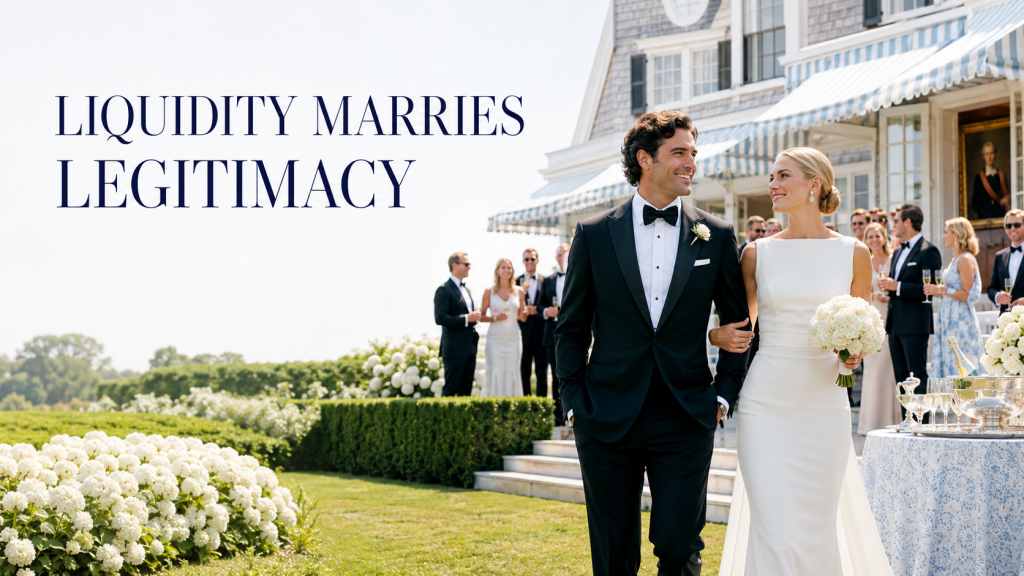
On the morning of November 6, 1895, Consuelo Vanderbilt stood in St. Thomas Church on Fifth Avenue and cried behind her veil. She was eighteen, in love with someone else, and about to become the Duchess of Marlborough anyway. Her mother had priced the title at roughly $2.5 million in railway stock, plus annual income, and found it fair. Nine centuries of name, bought at market. It remains the most famous old money marriage in American history, and the money was new. That was the entire point.
The trade she executed under duress runs voluntarily now, every season, on both forks. Liquidity still marries legitimacy, quietly and repeatedly, because each side holds the one currency the other cannot mint. This spoke of the Marriage Market series follows the oldest trade on the exchange.
The Dollar Princess Trade
Consuelo had company, and the company had a nickname. Between 1870 and 1914, hundreds of American heiresses crossed the Atlantic with industrial fortunes and returned with titles; the press called them dollar princesses, and society kept published directories of which peers remained available. Jennie Jerome went early, marrying Lord Randolph Churchill in 1874 and eventually giving the arrangement its most famous product: her son Winston.
Nobody involved pretended the mechanism was romance. British estates were cash furnaces with leaking roofs, and American railroad money wanted what no railroad could build: centuries. So the exchange cleared at scale, Blenheim Palace got its restoration, and a striking share of the twentieth-century British aristocracy grew up with American mothers. Each of those unions began as an old money marriage where the oldness and the money arrived from opposite shores.
History files this under quaint. The filing is premature, because the trade never actually closed. It just learned discretion.
What Each Side Cannot Mint
Strip the tiaras off and the structure is pure currency exchange. New money holds liquidity, the one asset that responds to effort: build the company, sell the company, wire the proceeds. Old money holds legitimacy, the one asset that responds only to time, because legitimacy is conferred by others and compounds across generations or not at all.
Neither side can produce the other’s holding, at any price, on any deadline. A founder cannot make his surname older. Likewise a legacy family cannot will its trust back to size, however distinguished the portraits watching them try. The impossibility is what makes the trade permanent, as the currency ledger of this series keeps demonstrating.
An old money marriage, in the modern sense, is simply the moment the two impossibilities solve each other. Each family exits holding what it could never mint. Economists would call it gains from trade. The mothers involved call it a lovely match.
The Trade Never Stopped
Watch any recent season out here and the Gilded Age pattern repeats at lower volume. A logistics exit marries a name that has chaired the same benefit since the sixties. A fund founder marries into a family whose hedgerow predates the highway, and within two summers he is posting from a club that ignored his membership inquiry for a decade. That is an old money marriage clearing, in real time.
The modern old money marriage drops the titles and keeps the mechanics. Legitimacy now lives in surnames, committee seats, club standing, and the quiet assumption of belonging, rather than in coronets. Liquidity looks the same as ever, only faster. And the estates still need their roofs, because old houses did not stop being cash furnaces when the dukes ran out.
Discretion is the one genuine innovation. Nobody publishes directories of available legacy families anymore. The matching runs through dinner parties, boards, and occasionally the professional tier, which understands this particular trade better than it advertises.
How the Trade Gets Negotiated
No term sheet ever surfaces, so the negotiation runs on proxies. The family table is the first session, as our hub on marrying well described: due diligence conducted over corn, with a grandmother as risk committee. Club sponsorship is the second session. A legacy family putting a new name forward is lending collateral, and everyone signing the letters knows it.
Later sessions get more explicit without ever becoming explicit. A foundation board seat appears. A wing acquires a hyphenated name. The newer fortune quietly assumes certain carrying costs, and the older family quietly stops mentioning them. None of this is written down, which is precisely why it holds; paper can be litigated, but conferred standing can only be withdrawn.
The whole choreography looks effortless from outside. From inside, every old money marriage is a multi-year integration, and both families are watching the synergies like analysts.
The Reverse Trade
One update since the Gilded Age deserves its own section: the trade now runs in every direction. Then, the pattern was fixed, American cash traveling toward European titles, daughters as the instrument. Today the legacy surname is as often hers as his, and the liquid party arrives from either side of the table.
A founder marries a fourth-generation name and gains the committee lists. Just as often now, a legacy daughter marries the fund, and her family gains the refill while she keeps the name that constitutes its capital. Keeping the name was once scandalous. In an old money marriage today it is closer to standard practice, for the same reason companies keep the older brand after a merger: that is where the equity lives.
The symmetry has improved the market’s honesty, if not its candor. Both directions clear, both sides know their column, and the only fixed rule left is the original one. Somebody brings the liquidity, somebody brings the legitimacy, and neither shows up holding both.
What Legitimacy Actually Delivers
Skeptics ask what the liquid side really buys, since belonging sounds like vapor next to a balance sheet. The answer is concrete and compounding. Membership stops being applied for and starts being offered. Committee lists open. Introductions arrive pre-warmed, because the surname now vouches before the person enters the room.
Above all, the assumption flips. New money spends its first decade being audited: every purchase read as trying, every gesture priced for effort. After an old money marriage, the same behavior gets read as belonging, and the audit quietly closes. That flip cannot be bought directly at any price, a conversion problem we mapped in Converting Success Into Status.
The children collect the full dividend, holding both currencies from birth. Which is why the shrewdest first-generation families think of the trade less as a wedding and more as chain-starting, the deliberate move we flagged in Why the Rich Marry the Rich.
What Liquidity Actually Delivers
Now reverse the flow, because the legacy side is not doing charity. Genteel poverty is real, common, and exhausting. Trusts thin across generations like soup, while the fixed costs of standing never thin at all: the house, the dues, the benefits, the appearance of ease that makes the legitimacy legible in the first place.
Liquidity solves the arithmetic. The roof gets fixed, the foundation gets refilled, and the family stays in the game whose rules it wrote. Staying in the game is the entire prize, since legitimacy uncirculated depreciates just like currency uncirculated. A great name that stops appearing stops conferring.
There is also an energy transfer nobody prices openly. New money brings appetite: the drive that built the fortune arrives at a family that has been coasting on formation for two generations. The strongest old money marriages run on that exchange as much as the financial one, ambition and polish trading at par across one breakfast table.
The East End Is Where It Clears
Every exchange needs a trading floor, and this trade found its American one. The Hamptons is the rare place where both populations concentrate voluntarily, all summer, in supervised contact. Legacy families hold the hedgerows, new fortunes rent toward them, and the social calendar introduces the columns eleven weekends in a row.
The season provides what the Gilded Age needed steamships for. Proximity, repetition, and enough public settings that the vetting happens in daylight, at benefits, across dinner tables, and on the polo field, where the two columns share cabanas without anyone calling it a market. By Labor Day the summer has done what a London season once did, minus the presentations at court.
So the geography is not incidental to the old money marriage. It is the mechanism. Concentrate both currencies on one strip of land, add champagne, and the exchange clears itself.
When the Trade Sours
Consuelo’s marriage supplies the cautionary ending too. Within eleven years the Marlboroughs had separated, divorced eventually, and the union was annulled in 1926, with her own mother testifying that she had forced the match. The dowry stayed at Blenheim. The duchess did not.
Modern failures are subtler, and they follow the pattern our hub called single-screen selection. A trade executed on currencies alone, with no matching formation underneath, completes and then discovers itself: two families holding what they wanted, two people holding a stranger. Resentment runs asymmetric, because one side always feels more purchased than the other, and asymmetry compounds at anniversaries.
The old money marriage that lasts clears both screens. The currencies complete each other, and the instincts rhyme anyway. When that happens the trade becomes invisible within a decade, which is the entire ambition: nobody prices a merger that looks like it was always one company.
The Third Generation Wins
Run the successful version forward and the payoff structure becomes clear. The first generation executes the trade and absorbs the friction. The second generation grows up bilingual, fluent in both liquidity and legitimacy, comfortable in rooms their grandparents could not have entered on either side.
By the third generation the merger is complete and undetectable. The surname reads as old, the money reads as always, and the family has become exactly the kind of counterparty its founder once had to court. Every old money marriage aims at this horizon, whether anyone says so at the wedding or not.
That is worth sitting with, because it reframes the whole trade. The dollar princesses were not buying husbands. They were buying their grandchildren a different starting line, and on that measure, most of the trades cleared handsomely. Ask the Churchills.
Where The Conversation Continues
This spoke serves both sides of our Marriage Market series, under the hub Marrying Well Is a Currency Exchange and the pillar that maps the full exchange. Still ahead: the bachelor the market stranded, the rooms where the trading happens, and the signals that price everyone walking in.
Social Life Magazine has documented both sides of this trade for 23 years, from the legacy committees to the new fortunes arriving at a certain polo field in Bridgehampton every July. If your business serves either column, the series is already circulating among your clients, and they know exactly which currency they are short. Reach out about features and partnerships. The directory of available legitimacy went out of print, but the readership did not.
One last note for the readers running the numbers on themselves. The old money marriage is not the only route to standing, just the fastest, and speed carries costs this series has already priced. Build the currencies you can mint, trade honestly for the one you cannot, and remember Consuelo. The trade works best when nobody at the altar is crying.
Author

Written by
Recent Posts

The First Decision After a Collision Can Be the Most Important One
Two Weeks in Rome and Beyond: Turkish Airlines Itineraries from Boston, Chicago and Onward to India

Top 10 Hair Transplant Clinics in Turkey 2026

Artist Alley to Online Store: How Convention Artists Can Keep Selling After the Event
When an 18-Wheeler Crash Leaves Lasting Consequences
Categories
- Art
- Articles
- Business of Luxury
- Celebrities
- Culture
- Entertainment
- Events
- Faces of Summer 2026
- Fashion
- Fashion & Style
- Featured
- Finance
- Food, Spirits, Wine
- Hamptons
- Hamptons Celebrities
- Health
- Health & Beauty
- Lifestyle
- Luxury Lifestyle
- Press
- Profiles
- Real Estate
- Technology
- The Chronicles
- Travel
- Uncategorized
- Weddings