
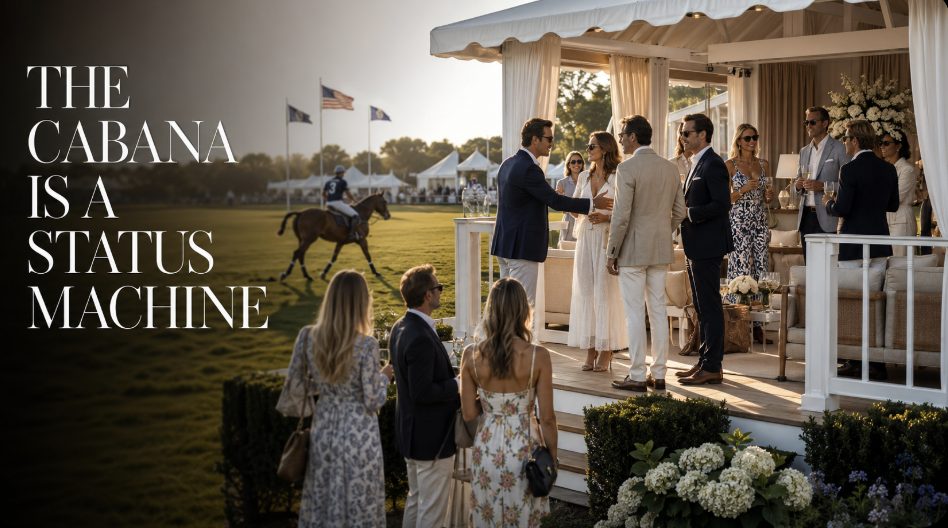
By the third chukker at Polo Hamptons, nobody is giving directions by field markers. Guests steer by tents. Meet me past the Hästens cabana, left of the champagne pour, two down from BMW. The lawn has been renamed by its sponsors, without a single banner doing the work. That renaming is the product, because a cabana is not shade with a logo. It is a status machine, a small piece of social architecture that converts square footage into standing, and this piece explains the machinery bolt by bolt.
Consider it the field manual companion to why luxury brands buy prestige, zoomed all the way in. The wide map is the economy of prestige. Here, the subject is twenty feet by twenty feet, four hours long, and routinely the best-performing line item in a luxury media plan.
What You’re Actually Buying
Most sponsors think a cabana purchase buys visibility with better furniture. What it actually buys is the status machine’s three mechanisms, which no other format offers together: territory, introductions, and memory. Each one compounds the others across the afternoon, which is why the format outperforms placements that reach a thousand times more people.
The comparison worth making is not cabana versus bigger cabana. It is cabana versus banner, because the banner is what the same budget buys in reach logic. A banner is wallpaper: seen by everyone, engaged by no one. Nobody meets anyone in front of a banner, so nothing compounds. The tent, by contrast, is a room, and rooms are where this market does business.
Territory, the First Mechanism
A cabana creates semi-private territory inside a public event, and that boundary does surprising work. The rope line manufactures the two things scarcity always manufactures: desire on one side and belonging on the other. Guests inside relax differently, because they were chosen, and chosen people talk more openly than ticketed ones. Even the rope earns its keep, and the rope costs nothing.
Territory also gives everyone a reason to return. Between chukkers, guests orbit back for a refill, a chair, and a familiar face, so the same people encounter each other three and four times in an afternoon. Repetition is the quiet engine here. Strangers become acquaintances on the second pass and contacts on the third, and the sponsor’s name presides over all of it.
The Introduction Engine
Introductions need pretexts, and the cabana is a pretext factory. The threshold itself creates one: someone must welcome you in, and a welcome is an introduction wearing a uniform. The pour creates another. So does the shade, the seating, and the view, since sharing any of them licenses conversation between strangers.
Watch the physics of it. Two guests who would never approach each other on an open lawn will happily talk while reaching for the same rosé. The cabana removes the social cost of the approach, because proximity was arranged by the space rather than claimed by either person. Nobody had to try, and in this market, not trying is everything. Architecture, in other words, does the networking so nobody has to.
The Landmark Effect
Across four hours, the tent graduates from structure to landmark, and landmarks enter memory with names attached. People remember where they met far more reliably than when, so the sponsor becomes the address of the afternoon’s best encounters. That is the status machine’s flywheel: the space becomes social memory, and social memory is the cheapest media in luxury.
The effect outlasts the event by months. That is where everyone ended up. That is where Christie stopped. Sentences like these circulate at dinners through Labor Day, and each retelling runs the sponsor’s name through the one channel no budget can buy directly: other people’s stories. The borrowed symbolism of the field rides along with every mention.
Anatomy of a Working Cabana
The best cabanas share a floor plan philosophy, and it is not maximalism. Keep the threshold open and staffed, because an unmanned entrance reads as either abandoned or forbidden. Seat fewer people than you could, since standing room is where mixing happens and couches trap conversations in place. Put the pour at the back, so every refill walks the full room.
Then give the space one object worth touching: the bed, the car, the bottle, the chair. One, not twelve. A single beautiful object starts conversations, while a product table ends them, because tables turn guests back into shoppers. Signage follows the same restraint. The name should be findable, not inescapable, since the landmark effect does the shouting for you. Think salon, not showroom.
The Cabana Next Door
Placement inside the row matters nearly as much as the tent itself, because the row functions as a street. Foot traffic flows toward anchors: the champagne pour, the trophy stage, the best sightline to the ponies. A cabana positioned along that current borrows its energy, while a beautiful tent in a dead corner spends the afternoon proving the point.
Neighbors matter too, and the smart sponsors ask about them before signing. The right adjacency lends audience: guests drift between compatible tents, and each threshold introduces people the other collected. By contrast, the wrong neighbor leaks the wrong crowd into your carefully built room. Ask for the map early, since the map is negotiable exactly once.
Programming the Four Hours
A cabana without a rhythm underperforms, so borrow the event’s own clock. Arrival hour is for the threshold: greet, pour, and seed the first introductions while energy is high. Mid-match, the divot stomp empties every tent onto the field, and smart sponsors walk their guests out together, because shared rituals bond faster than shared shade.
The trophy hour and the golden hour close the show. Photography concentrates then, so that is when the object, the host, and the best guests should be arranged near the front. Afterward, the last thirty minutes matter most of all. Departures are when numbers get exchanged, and the cabana that stays warm to the end collects them.
A Working Afternoon, Reconstructed
Compress the good versions into one composite afternoon. At one, the host stands at the threshold greeting arrivals by name, and the first pour lands within a minute of each welcome. By two, three introductions are already running, seeded deliberately: the founder to the developer, the surgeon to the editor, the new arrival to the committee chair.
At halftime, the whole tent walks the divot stomp together and returns louder. During trophy hour, the object gets its moment in front of the photographers, framed by the day’s best-dressed conversations. At six, departures stack at the threshold, numbers change hands, and the host books two follow-ups before the valet line clears. Nothing about the sequence is luck. All of it is architecture, run on schedule. Total staff required: one good host and one better list.
The Host, Not the Ambassador
Staffing decides more outcomes than design does. A brand ambassador performs the brand at guests, while a host connects guests to each other, and only the second one operates the machine. The ideal host knows half the list already, remembers names, and treats introductions as the deliverable. Titles impress nobody at a threshold, while warmth staffs it better. The product conversation happens later, and it happens because the introductions happened first.
This is also why the sponsor’s own principals should attend rather than delegate. A founder standing in the tent converts it from media buy to invitation, since guests read presence as hospitality and absence as transaction. Hospitality, as the pillar argues, is the oldest conversion technology out here.
The Failure Modes
The same mistakes repeat every season, and all of them are fixable in advance. Over-branding is the most common: wrap every surface and the room reads as a trade show booth, which repels exactly the guests you wanted. The second failure is the closed circle, where staff and executives talk to each other while guests drift. Assign the circle-breaker role explicitly.
Third is the empty-cabana problem, usually caused by inviting only clients instead of curating a mix worth meeting. People come for the other people, so the list is the product here too, exactly as the guest list is the product argues. Finally, the swag table: generosity is welcome, but merchandise turns a salon into a sample sale. Send the gift afterward, with a note, when it reads as thanks instead of bait. Every failure on this list jams the status machine the same way, because every one of them stops an introduction.
The Press Pairing
The machine’s output doubles when documented, which is the bundle rule working at tent scale. Photographers gravitate to the best-composed cabanas, and editors remember the sponsors who made the day photogenic. The photographers, notably, are the cheapest distribution on the lawn. A season later, the archive shows your tent as the place the afternoon happened, and the archive works while you sleep.
So pair the purchase deliberately: cabana plus coverage, presence plus record. The mechanics of that pairing are the subject of editorial vs. advertising, but the short version fits here. The tent creates the moment, and the page makes the moment permanent. Buy them together, because each without the other returns half the yield.
The Second Season
The machine’s best output arrives in year two, which surprises sponsors who measured only year one. Returning guests walk toward the tent they remember, so the second season opens with the first season’s relationships already seated. The name stops being a sponsor and starts being a fixture, and fixtures collect the field’s default trust. Ask the brands whose corners now give directions.
Renewal economics follow from this. A single summer buys an audition, while consecutive summers buy a position, and the market prices continuity above intensity in tents exactly as it does in people. Skip a year and the landmark resets. Hold the corner, though, and eventually guests believe the lawn was always yours. Belief of that kind is the whole point of the spend.
What to Count Afterward
Measure the machine by what it manufactures, not by tonnage. Count names collected and, more importantly, names remembered. Spreadsheets travel poorly to lawns, but names travel fine. Count the follow-ups booked within two weeks, since the two-week window is where the afternoon either converts or evaporates. Then count the photographs in circulation, especially the ones you did not take.
Afterward, apply the density test from the death of impressions. Eighty of the right guests in your tent outperform eighty thousand scrolling past a placement, and the gap widens with price point. If the format still needs defending in your planning meeting, run one season and count again. The status machine argues best in person.
The Machine Travels
Nothing about the machinery is polo-specific, although the field supplies the best conditions. The same three mechanisms run at a vineyard dinner, a gallery night, a regatta, or a summer sharehouse. Wherever a boundary can be drawn, a threshold staffed, and a pour placed at the back of the room, the machine assembles itself.
The estate version deserves special mention, because it trades reach for total control of the list. A brand hosting twenty at a Sag Harbor guest house runs the cabana play at dinner-party scale, and the conversion rate climbs accordingly. The infrastructure behind that move is mapped in the Hamptons house as social infrastructure. Scale the boundary to the ambition, then staff it the same way.
One warning travels with it: the machine only runs where the list is curated. Open the boundary to everyone and you have built a very nice bus shelter.
Where The Conversation Continues
Cabana inventory at Polo Hamptons is fixed by the field, and category exclusivity holds inside it: one bed, one automaker, one pour. The machines on this lawn are limited, in other words, and they are assigned in the order the calls arrive. If your brand needs a room instead of a placement next July, the partnerships desk builds exactly one per category. The field remembers whose tent it was. So does the archive.
Author

Written by
Recent Posts

The First Decision After a Collision Can Be the Most Important One
Two Weeks in Rome and Beyond: Turkish Airlines Itineraries from Boston, Chicago and Onward to India
Top 10 Hair Transplant Clinics in Turkey 2026
Artist Alley to Online Store: How Convention Artists Can Keep Selling After the Event
When an 18-Wheeler Crash Leaves Lasting Consequences
Categories
- Art
- Articles
- Business of Luxury
- Celebrities
- Culture
- Entertainment
- Events
- Faces of Summer 2026
- Fashion
- Fashion & Style
- Featured
- Finance
- Food, Spirits, Wine
- Hamptons
- Hamptons Celebrities
- Health
- Health & Beauty
- Lifestyle
- Luxury Lifestyle
- Press
- Profiles
- Real Estate
- Technology
- The Chronicles
- Travel
- Uncategorized
- Weddings