
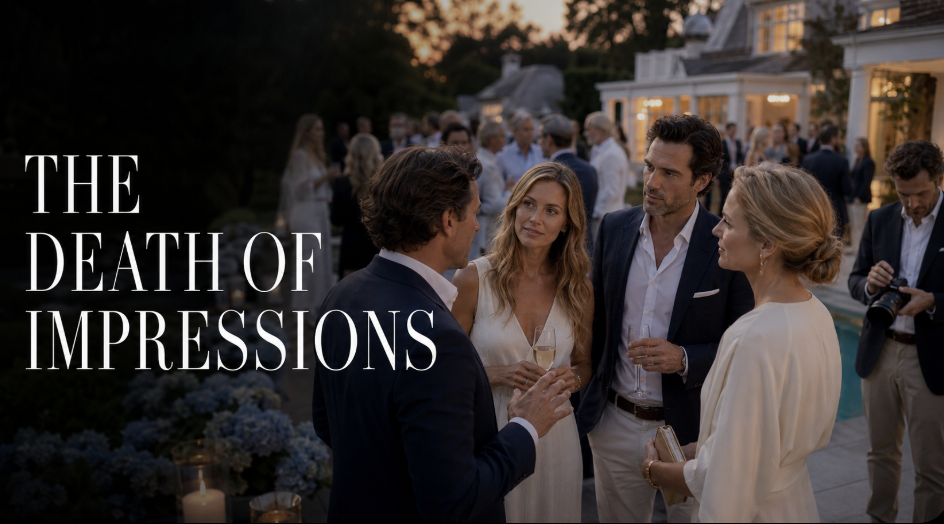
Every spring, in a conference room above Madison Avenue, the same scene plays out. A media planner presents two options, and the one with the bigger number wins. Two million impressions beats two thousand attendees on every slide, because slides are where big numbers live their best lives. Then the quarter ends, the phones stay quiet, and somebody asks why the reach never became revenue. Welcome to the death of impressions, the slow-motion retirement of luxury marketing’s favorite wrong number. The number was never wrong, exactly. It was answering a different question.
This piece is the measurement argument behind why luxury brands buy prestige, with the arithmetic shown. The wider market it serves is mapped in the economy of prestige. The claim here is narrow and confident: impressions measure distribution, luxury runs on distinction, and a metric built for one cannot price the other.
Where Impressions Came From
The impression was invented for mass media selling mass products, and in that world it worked. Soap needs everyone, so counting everyone made sense. Tonnage logic built the entire measurement stack that followed: reach, frequency, CPM, and the comfortable illusion that attention is a commodity sold by the pound.
The stack survived the shift to digital because it got cheaper to run, not because it got truer. Platforms industrialized the count, then sold the count as the outcome. For most products, the approximation still holds well enough. For luxury, it never held, and the gap has been widening every year since targeting became theater.
The Luxury Mismatch
Luxury sells scarcity, and tonnage contradicts scarcity at the level of physics. A product whose value depends on not everyone having it cannot be marketed as if everyone should. So every incremental impression past the right audience does not merely waste money. It actively dilutes the thing being sold, because ubiquity is the category’s poison. No waitlist was ever built by being everywhere.
The mismatch runs deeper than waste. Mass metrics reward being seen, while luxury rewards being placed: the right field, the right pages, the right dinner. Placement is a judgment call no counter can make. In fact, the moment a counter can make it, the placement has stopped being exclusive enough to matter.
What an Impression Actually Is
Run the honesty audit on the unit itself. An impression is a maybe: maybe rendered, maybe seen, maybe by a human, maybe for a third of a second. Nothing about the unit records whether attention occurred, let alone whether standing changed. It is a receipt for delivery, not for arrival. The unit, in short, is optimism sold by the thousand.
Now price the maybe against this audience specifically. The reader luxury wants has spent decades building immunity to interruption, so the glance that does occur bounces off a trained filter. Counting those glances by the million produces a large number describing almost nothing. Large numbers describing nothing are still the easiest thing to sell in a planning meeting, which is the whole problem.
How the Metric Survived This Long
A fair question: if the metric fails luxury this badly, why is it still everywhere? Because every party at the table is paid to keep it. Agencies bill against volume, so volume is what gets planned. Platforms grade their own homework, and the grades are predictably excellent. Planners need a number that survives a meeting, and big numbers survive meetings beautifully.
Nobody in that chain is lying, exactly. Each is optimizing a system that measures what is easy instead of what is true, and easy metrics are institutionally immortal. The death of impressions has been announced before, of course. What is different now is that luxury CMOs finally hold a replacement ruler, and rulers, once picked up, are hard to put down. Convenience, after all, has a lobby. Accuracy has this article. The lobby, to be clear, buys lunch, not results.
The Wrong-Audience Tax
Even granting the glance, most of the two million were never buyers. Targeting narrows the pool, but targeting works from proxies, and proxies for wealth are famously bad. Zip codes rent. Interest signals lie. Lookalike audiences resemble your customers the way a costume resembles a person. The residue is a tax paid on every campaign: the majority of spend lands on people outside the market entirely. Efficiency, notably, was supposed to be the whole pitch.
The tented lawn runs the opposite math. At an invitation-built event, curation happens before the spend rather than after it, so the wrong-audience tax approaches zero. Two thousand attendees sounds small until you ask how many of the two million were ever in the market. Then it sounds efficient.
The Signal Cost of Cheap Reach
Reach also carries a signal cost that never appears on the invoice. Being everywhere tells the market you need everyone, and needing everyone is the opposite of the luxury promise. Sophisticated buyers read media presence the way they read behavior at a party: frequency past a point stops looking confident and starts looking hungry.
Scarce placement sends the opposite signal at the same budget. One field, one book, one dinner series says the brand chooses its company, and choosing is what this audience respects. The medium is doing the talking either way. The only question is what it says, and cheap reach says the quiet part loudly.
Density, Defined
If impressions die, something must replace them, and the replacement is density. Density asks three questions of any room, page, or lawn. Who is actually present, named rather than modeled? How likely is each of them to buy, refer, or invite? How connected are they to the next hundred people you want?
Multiply those answers and you have priced the room, which no CPM can do. The death of impressions is really the birth of this ruler, and the ruler travels: it prices a cabana, a feature, an estate dinner, and a gala table on the same scale. Suddenly the media plan and the event budget speak one language, and the language is people. Small numbers, honestly counted, beat large numbers honestly meaningless.
The Density Math, Worked
Work one comparison honestly, with round numbers and labeled assumptions. Eighty of the right guests spend an afternoon in your tent at Polo Hamptons. Suppose a tenth of them convert to a relationship worth having, and each relationship is worth what one high-net-worth client is worth in your category. For a medspa, a builder, a bank, or a bedmaker, that is a number with commas.
Against it, place eighty thousand scrolled impressions. Apply generous click and conversion rates and the arithmetic still struggles to produce one client of the same caliber, because caliber was never in the pool. The gap widens as the price point rises. At the top of the market, the tent stops competing with the feed entirely. They are not the same purchase, and only one of them was ever priced correctly. Label the assumptions and argue them openly, because the frame survives the argument.
The Second-Order Audience
Density also pays a dividend impressions cannot: the second telling. The right eighty guests talk to the next eight hundred, because this market moves on recounted afternoons and forwarded features. A story travels through dinners, group chats, and club locker rooms, carrying the brand with it. Impressions do not refer. People do. Word of mouth is just density paying interest. The eight hundred, notably, arrive pre-sold by the eighty.
The cabana piece shows this flywheel at tent scale, and the editorial version compounds even harder, since a page can be photographed, linked, and framed. Second-order reach is unpriced in every media kit, ours included. It is also, quietly, most of the value.
What to Measure Instead
Replace the dashboard with a shorter, harder list. Count names remembered, not badges scanned. Follow-ups booked inside two weeks come next, since afternoons either convert or evaporate on that clock. Then track inbound quality: who calls, what they open with, and whether the discount question has disappeared from the conversation. The list fits on an index card, which is rather the point.
Then count the season, not the month. Prestige metrics move quarterly and compound annually, as the hub lays out, so the reporting cadence has to match the asset. A brand that insists on weekly attribution is demanding that a vineyard behave like a vending machine. The vineyard will not, and it should not.
The Dashboard Objection
The objection arrives on schedule: the CFO needs numbers. Correct, and density produces better ones. Cost per relationship beats cost per thousand for any product with a five-figure ticket, because it prices the actual unit of revenue. Build the sheet with named rooms, conversion assumptions you can defend, and season-over-season retention of the relationships created.
What the CFO actually objects to is unfamiliarity, not rigor. The death of impressions does not mean the death of accountability. It means accounting for the right thing, at the right cadence, in units a luxury P&L recognizes. Most finance chiefs convert quickly once relationship math is on the page. It resembles how they already think about their own careers. Bring the ruler, in other words, before someone else brings the deck.
A Tale of Two Recaps
Picture two post-campaign recaps landing on the same desk in September. The first is a deck: reach, frequency, engagement rate, a heat map, and a slide of superlatives. Impressive, dense with charts, and silent on revenue. The second is a memo, one page. Forty-one names, eleven follow-ups booked, three proposals out, two closed, one board introduction pending.
The deck cost more to produce than the memo cost to earn, and only one of them gets forwarded to the CEO. By renewal season, the difference has compounded. Charts argue for budgets, but names argue for strategies, and strategy is where the multi-year money sits. Write the memo. The deck can attend as a supporting document. September, incidentally, is when next July gets decided.
When Impressions Still Matter
Honesty requires the counterweight, so here it is. Impressions still serve launches, where controlled timing matters more than conferred standing. They serve the accessible tier of a luxury house, where volume genuinely is the model. And they serve as air cover behind a density strategy, reminding the market of a judgment already made, as editorial vs. advertising argues in full.
The correction, then, is not abolition but demotion. Impressions become a supporting instrument, priced as one, while the room becomes the lead purchase. Most luxury plans currently run that hierarchy upside down. Turning it right side up is the cheapest strategy upgrade available this season.
The Transition Plan
No CMO should flip an entire budget on an argument, however sound, so run the transition as a pilot. Carve out a defensible slice of the plan for one season. Buy one room and one feature with it, measured on the density ruler from the start, while the rest of the budget runs as usual. Parallel measurement settles the death of impressions faster than any deck could.
Come September, place the two recaps side by side, exactly as described above. If the names beat the tonnage, and at this price point they will, next year’s hierarchy writes itself. If they somehow do not, you have lost one line item and gained a controlled experiment. Either outcome beats another year of confident guessing. Pilots, conveniently, are also how careers survive being right early.
Where The Conversation Continues
Social Life sells density and always has: 25,000 summer print copies in the right houses, an 82,000-subscriber list built over 23 years, and a July field where the audience arrives pre-curated with the cameras working. If your brand is done paying the wrong-audience tax, the partnerships desk prices rooms, pages, and lawns on the ruler this piece just handed you. Bring your current media plan. The comparison takes one meeting, and it is rarely close.
Author

Written by
Recent Posts

The First Decision After a Collision Can Be the Most Important One
Two Weeks in Rome and Beyond: Turkish Airlines Itineraries from Boston, Chicago and Onward to India

Top 10 Hair Transplant Clinics in Turkey 2026
Artist Alley to Online Store: How Convention Artists Can Keep Selling After the Event
When an 18-Wheeler Crash Leaves Lasting Consequences
Categories
- Art
- Articles
- Business of Luxury
- Celebrities
- Culture
- Entertainment
- Events
- Faces of Summer 2026
- Fashion
- Fashion & Style
- Featured
- Finance
- Food, Spirits, Wine
- Hamptons
- Hamptons Celebrities
- Health
- Health & Beauty
- Lifestyle
- Luxury Lifestyle
- Press
- Profiles
- Real Estate
- Technology
- The Chronicles
- Travel
- Uncategorized
- Weddings